
Posts

What Is a Backlit Letters Sign and How Does It Work?

A Backlit letters sign is a dimensional sign designed to make a brand visible after sunset. It usually combines raised metal or acrylic letters with internal LEDs, a translucent face, and a carefully sized power supply. Depending on the design, the light may shine through the letter face or create a soft halo against the wall. That distinction matters. Many buyers call both styles “backlit,” although their construction and visual effect are different.

The Sign Research Foundation’s research on on-premise signage emphasizes viewing distance, contrast, legibility, and placement as practical performance factors. A beautifully illuminated letter can still fail when trees, glare, or poor mounting reduce visibility. At installation, experienced sign teams inspect the wall, measure sightlines, and test brightness at dusk. Small details matter. LED spacing affects dark spots. Color temperature changes the brand’s character. Ventilation influences component life. The U.S. Department of Energy’s solid-state lighting research also explains that LED performance depends on thermal management, optical design, and electrical control. Energy efficiency is useful, but it is not automatic.

Market demand supports this attention to detail. The Out of Home Advertising Association of America’s recent revenue reports show continued investment in visible, location-based advertising across the United States. That growth does not guarantee results for every storefront. This is the part worth questioning. A brighter sign is not always a better sign. Effective design balances readability, energy use, maintenance access, local conditions, and brand consistency. In the sections ahead, we will examine how these signs are built, how their lighting works, and why professional specification matters.
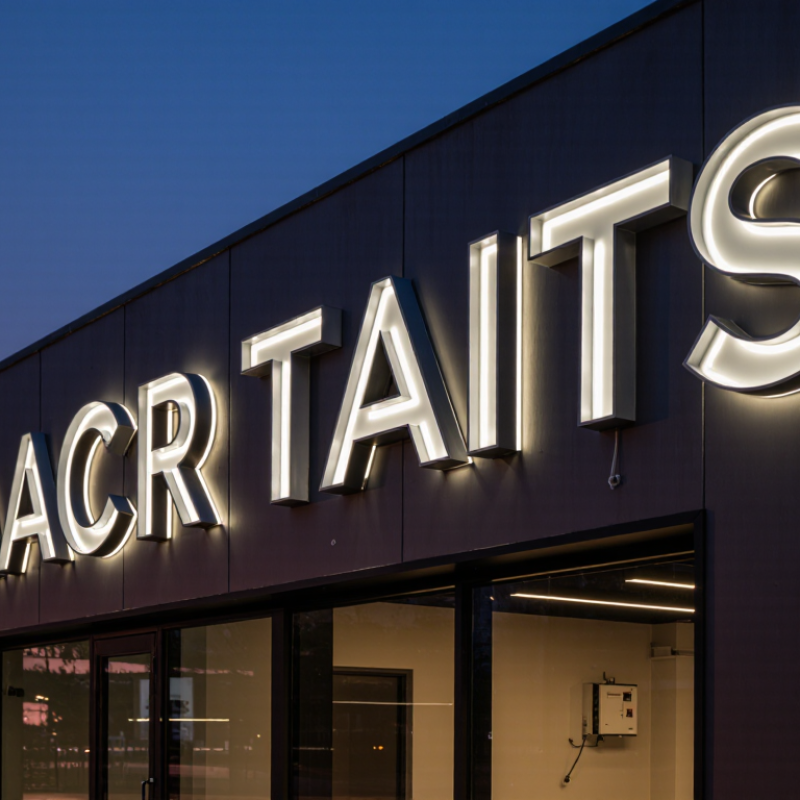
What Is a Backlit Letters Sign and How Does It Work?

What Is a Backlit Letters Sign? Definition and Typical 3–5 mm Faces

What Is a Backlit Letters Sign and How Does It Work?

A backlit letters sign uses individual letters with light sources installed behind each letter. The LEDs shine toward the wall, creating a soft halo around the edges. Unlike front-lit lettering, the letter faces remain mostly opaque, while the background carries the visual glow.

In typical fabrication, the visible faces are made from 3–5 mm acrylic, aluminum, or another rigid material. Acrylic offers clean edges and stable color, while aluminum provides stronger impact resistance. The face attaches to a deeper return, which forms the letter’s side structure. LED modules sit inside this cavity, spaced to spread light evenly across the rear surface.

The wall finish matters more than many people expect. A pale, smooth wall reflects the glow clearly, while rough or dark surfaces reduce brightness. During installation, technicians check letter spacing, fixing points, cable routes, and nighttime visibility. A small gap behind each letter is essential for the halo effect.

From practical sign projects, I have found that brighter is not always better. Excessive output can create harsh shadows or uneven hotspots. A 3–5 mm face may look precise, but poor internal spacing can still weaken the result. Weather sealing and drainage also require attention, especially on exterior walls. Sometimes the first design looks perfect on screen and feels too heavy after installation. That is worth reviewing before production.

What Is a Backlit Letters Sign and How Does It Work? - What Is a Backlit Letters Sign? Definition and Typical 3–5 mm Faces

Data Dimension Typical Specification or Fact How It Affects the Sign
Definition A three-dimensional sign in which light is positioned behind individual letters or symbols. Creates a halo or reverse-lit effect around the characters instead of illuminating only their front surfaces.
Typical face material Aluminum, acrylic, stainless steel, or another weather-resistant sheet material. Determines the letter’s appearance, stiffness, corrosion resistance, and finishing options.
Typical face thickness Approximately 3–5 mm for many rigid acrylic or metal face applications. Provides a practical balance between rigidity, weight, edge quality, and fabrication cost.
Letter depth Common fabricated depths are about 50–150 mm, depending on letter size and design. Provides space for the light source and helps control the brightness and spread of the halo.
Lighting source Low-voltage LED modules or LED strips are commonly installed inside or behind the letters. LEDs provide efficient illumination, long service life, and relatively low heat output.
Light direction Light is directed toward the mounting surface, leaving a controlled gap between the letter and the wall. The reflected light forms a visible outline or halo around each letter.
Typical wall clearance Approximately 25–75 mm, depending on the desired halo width and installation conditions. A greater clearance can broaden the light spread, while a smaller clearance produces a tighter halo.
Power requirement LED systems commonly operate at 12 V or 24 V DC and require a suitably rated driver or power supply. The power supply must match the total wattage, voltage, wiring length, and environmental conditions.
Energy use LED illumination generally consumes less electricity than comparable fluorescent or neon systems. Can reduce operating costs, especially when the sign is illuminated for long periods.
Halo appearance The effect may appear as a soft outline, a narrow glow, or a broader wash of light. Appearance depends on letter depth, wall color, mounting distance, LED spacing, and surface reflectivity.
Daytime visibility The unlit face remains visible through its color, finish, shape, and dimensional projection. A suitable face finish helps maintain readable branding or directional information in daylight.
Outdoor protection Outdoor installations should use sealed components, protected wiring, drainage provisions, and weather-resistant finishes. Improves resistance to rain, dust, condensation, ultraviolet exposure, and temperature changes.
Main advantages Dimensional appearance, refined nighttime visibility, low-voltage operation, and flexible material and color choices. Suitable for building façades, reception areas, retail locations, hospitality venues, and wayfinding applications.

Which Components Create the Sign? LEDs Rated for Up to 50,000 Hours

A backlit letters sign uses individually shaped letters with light projected through a rear gap. The main components are the face, return, back panel, LED modules, wiring, and power supply. LEDs sit inside each letter, usually behind a translucent acrylic face. Their light spreads forward and creates an even halo or illuminated surface.

A 50,000-hour LED rating sounds impressive. It equals about 5.7 years of continuous operation. However, this figure usually describes rated useful life, not guaranteed failure-free service. IES LM-80 testing measures lumen maintenance, while TM-21 methods project future performance from that data. In practice, heat, dust, moisture, and overloaded power supplies can shorten service life. Thermal design matters more than the headline number.

The U.S. Department of Energy’s solid-state lighting forecasts estimate that LED adoption could reduce lighting electricity use by up to 86% by 2035 compared with conventional lighting. A backlit sign can support that efficiency when its components are matched correctly. A regulated power supply prevents unstable current. Aluminum returns help move heat away from the LEDs. Proper spacing prevents bright spots between modules. Small installation errors remain common. Uneven wiring can make one letter dimmer than another, and poor sealing can damage the sign before the LEDs reach their rated hours. Experience shows that testing the sign at night reveals problems that daytime inspections often miss.

How Does Backlighting Work? From LED Modules to Even Halo Illumination

What Is a Backlit Letters Sign and How Does It Work?

A backlit letters sign uses LEDs behind acrylic, metal, or translucent faces. Light travels forward, then spreads through a shaped return. The goal is an even halo around each letter. LED modules sit inside the letter cavity. Their spacing, lens angle, and brightness control the final effect. A reflective interior improves light recovery, while a dark interior can create dull corners.

The U.S. Department of Energy reports that LED lighting can use at least 75% less energy than incandescent lighting. Its 2023 Solid-State Lighting R&D Opportunities report also discusses LED efficacy above 200 lumens per watt in research conditions. Installed signage usually performs below laboratory results. Heat, wiring losses, diffuser thickness, and outdoor exposure matter. That difference deserves attention. Perfect uniformity is rarely perfect.

Tips: Keep LED modules away from sharp bends and deep recesses. Follow the manufacturer’s spacing plan, then test one full-size letter. Check it at night and from the normal viewing distance. Bright spots often reveal poor module placement. A dimmer power supply may improve comfort, but excessive dimming can change color consistency. Seal cable entries carefully. Moisture is a quiet problem. During maintenance, photograph the original wiring before replacement. Small records prevent larger mistakes.

What Is a Backlit Letters Sign and How Does It Work?

Backlit letters use LED modules behind translucent faces to create a soft halo or evenly illuminated surface. The chart below shows the idealized inverse-square relationship between LED-to-face distance and relative illuminance.

In the ideal point-source model, doubling the distance reduces illuminance to one-quarter. Real signage uses multiple LED modules, optical lenses, reflective returns, and translucent acrylic or vinyl faces to overlap light and produce a more uniform halo. The values are normalized to 100% at 25 mm and are intended to demonstrate the lighting principle rather than define a fixed sign specification.

How Are Safety and Weather Resistance Measured? UL 48 and IP65 Ratings

A backlit letters sign uses LEDs behind translucent faces, creating an even glow after dark. The enclosure must control heat, moisture, wiring, and light leakage. Safety and weather resistance are measured separately, not assumed from appearance.

UL 48 evaluates electric signs for construction, insulation, grounding, wiring, and protection against fire and electric shock. It is a product safety standard, not simply a waterproof score. The 2023 National Electrical Code also requires listed equipment and suitable installation conditions. In practice, technicians inspect cable entries, drainage paths, and internal connections.

Small gaps matter. I have seen a clean-looking sign fail because one unsealed gland trapped rainwater.

IP65 follows IEC 60529. The first “6” means dust-tight protection. The second “5” means resistance to water jets from a 12.5-millimeter nozzle, under defined test conditions. It does not mean submersion protection. Testing usually uses approximately 12.5 liters of water per minute, but real exposure includes wind, temperature changes, and aging seals. The International Energy Agency’s 2023 lighting analysis also shows why LED systems need reliable thermal management; lower energy use does not remove heat-related failure risks. Ratings help, but installation quality still decides performance. That part is easy to underestimate.

How Are Brightness, Spacing, and Energy Use Determined in Practice?

A backlit letters sign uses light sources behind individually shaped letters. The glow escapes around each letter’s edge and creates a clean halo on the mounting surface. In practice, brightness, spacing, and energy use must be balanced together.

Brightness begins with viewing distance, background color, and surrounding light.

A busy street usually needs stronger output than a shaded building entrance. Designers often test a sample letter at night, then measure luminance with a meter. Human judgment still matters.

Excessive brightness can flatten the letter shape and cause glare. Diffusers, LED placement, and the depth of the return channel also affect uniformity. A shallow letter may show bright spots, even when the rated output seems correct.

Spacing is measured from the letter edges, not only from the artwork file.

Narrow gaps can merge visually after illumination, especially in rounded characters. A practical layout leaves enough separation for shadows, cleaning, and installation tolerances.

I have found that a small spacing adjustment often improves readability more than adding light.

Energy use depends on the number of modules, their wattage, operating hours, and power-supply efficiency.

A simple estimate multiplies connected load by daily operating time, then includes a safety margin. Dimming controls can reduce nighttime consumption. They also reduce glare.

No estimate is perfect, because dust, aging LEDs, and changing wall reflectance affect real performance. Final testing should happen on the actual facade, not only on a computer screen.