Which Lithium Battery Type Is Best in 2026?
Which Lithium Battery Type Is Best in 2026?
Choosing the best Lithium Batteries for 2026 starts with a practical question: best for what? A campervan parked overnight, a family car in winter, and a solar backup system do not need the same battery. The chemistry affects price, weight, usable capacity, charging speed, and service life. One number cannot tell the whole story.
Dr. Shirley Meng, a leading battery scientist, has emphasized that battery choices depend on their intended use. In paraphrase: “No battery chemistry is best for every application.” That distinction matters. Lithium iron phosphate (LFP) is often attractive for stationary storage and vehicles where durability and cost matter. Nickel manganese cobalt (NMC) can offer more energy in a smaller, lighter pack. Lithium titanate (LTO) can charge quickly and endure many cycles, but often costs more and stores less energy for its size. Trade-offs are real.
In 2026, solid-state batteries may draw headlines, yet availability, cost, and real-world performance still deserve scrutiny. A showroom claim is not a decade of field data. Look closely at the complete system: temperature limits, battery management, warranty terms, and the supplier’s tested cycle-life figures. A cold garage can change performance. So can poor installation. Even a careful comparison has gaps, because published tests may not match your daily use. The “best” choice is therefore a fit, not a winner’s medal. Start with your actual load, climate, budget, and expected years of service. Then compare chemistries with those needs in view.
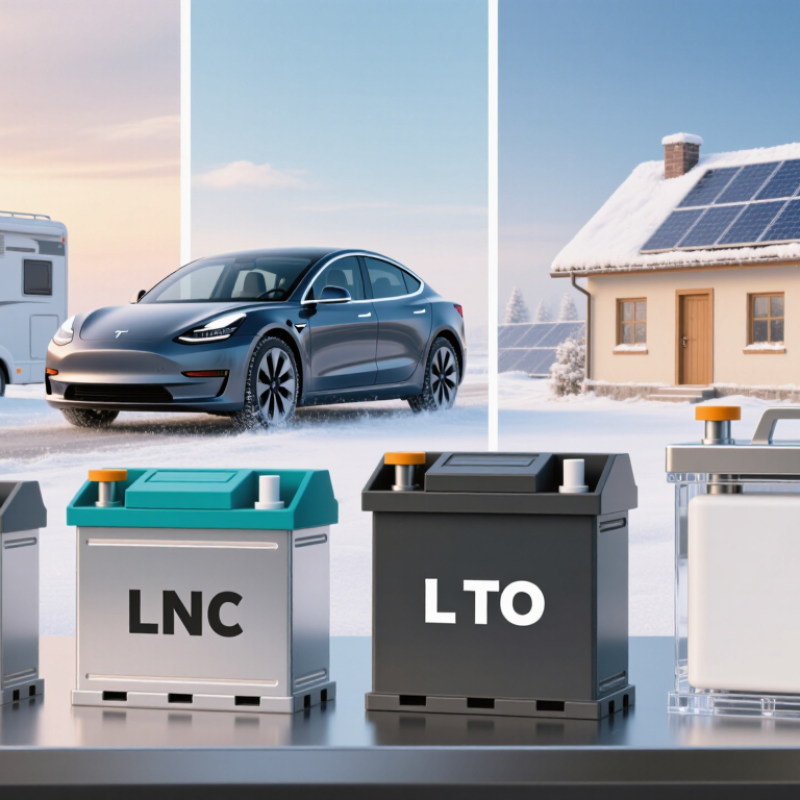
Define “Best” by Safety, Energy Density, Cost, and Service Life
Which Lithium Battery Type Is Best in 2026?
“Best” depends on what the battery must do. For a home backup system, safety and years of dependable cycling may matter more than a compact size. For an electric vehicle with limited space, energy density can carry greater weight. Compare the complete system, including thermal controls, charging equipment, and replacement costs—not just the cell price.
Lithium iron phosphate (LFP) generally offers strong thermal stability and long service life, but stores less energy per unit of weight than some alternatives. Nickel-rich chemistries, including NMC, can provide higher energy density, though they need careful heat management. Lithium titanate can handle frequent cycling and rapid charging, but typically costs more and takes up more space. No chemistry wins every measure. Real-world life also depends on temperature, charge limits, and how often the battery is deeply discharged.
Tips: Check the manufacturer’s cycle-life test conditions, not only the headline figure. Ask how capacity changes in cold or hot conditions. A battery that looks cheaper may cost more if it needs earlier replacement. I would still leave room for uncertainty: laboratory results rarely match every household or vehicle’s daily routine.
Compare LFP, NMC, NCA, LTO, and LMFP by Chemistry and Performance
Which Lithium Battery Type Is Best in 2026?
LFP suits buyers who value thermal stability, long service life, and lower material costs over compact size. Its energy density is generally lower than nickel-rich alternatives. NMC balances energy density and power, making it useful where space and range matter. NCA also offers high energy density, but relies heavily on nickel and cobalt. LTO prioritizes rapid charging and long cycle life, with a substantial energy-density penalty. LMFP adds manganese to LFP chemistry, aiming for higher voltage and energy density; real-world results still depend on cell design. No chemistry wins every test.
The International Energy Agency’s Global EV Outlook 2024 reports that LFP reached nearly 40% of global electric-vehicle battery demand in 2023. Its share was below 10% in 2020. Tips: Compare usable energy, charging needs, temperature range, and expected cycle life—not chemistry names alone.
For a stationary system, LFP may be the practical choice. For tight vehicle packaging, NMC or NCA can deliver more energy in less space. LTO can suit frequent, fast-charge operation, though its lower energy density demands more room. LMFP is promising, but published results and commercial availability vary. Check independent test conditions: temperature, charge rate, and depth of discharge change the numbers. A specification sheet rarely tells the whole story.
IEA: LFP Reached Nearly 40% of the Global EV Battery Market in 2023
In 2023, lithium iron phosphate batteries, or LFP, reached nearly 40% of the global electric vehicle battery market, according to the International Energy Agency. That is a substantial share, but it does not prove LFP is the best choice for every vehicle. Market growth reflects cost, supply, and vehicle design—not just battery performance.
LFP cells generally offer long service life and strong thermal stability, while avoiding nickel and cobalt in their cathode chemistry. Their trade-off is lower energy density than some nickel-rich alternatives. That can mean a heavier pack or less driving range for the same space. For a commuter who charges overnight and drives predictable routes, that compromise may be barely noticeable. That matters.
The IEA figure describes a market, not a direct test of every battery in every climate. Cold weather, charging habits, pack design, and warranty terms can all affect real-world results. A buyer comparing vehicles should check usable range and cold-weather performance, not chemistry labels alone. I would be cautious about treating one year’s market share as a forecast for 2026; the statistic is useful context, not a verdict.
BloombergNEF: 2024 Pack Prices Averaged $115/kWh, Down 20% YoY
BloombergNEF’s 2024 battery survey put the average lithium-ion pack at $115 per kilowatt-hour, a 20% drop from 2023. That is a market average, not a quote for every chemistry or project. Cell format, contract terms, factory location, and pack design can shift the final cost. A buyer comparing two systems should check what the price includes, down to cooling hardware and warranty assumptions.
For many cost-sensitive vehicles and home-storage systems, lithium iron phosphate (LFP) looks compelling. The International Energy Agency’s Global EV Outlook 2024 reported that LFP made up nearly 40% of the electric-car battery market in 2023. It generally offers long cycle life and avoids nickel and cobalt, but its lower energy density can mean a heavier, larger pack. Nickel-rich chemistries may suit vehicles where space and driving range matter more. Not every use case needs that trade-off.
The $115 figure is useful, but blunt. A lower upfront price does not automatically mean lower lifetime cost; real-world temperature, charging habits, and usable capacity matter. And forecasts for 2026 remain uncertain. Chemistry labels alone cannot settle the choice.
Match Battery Chemistry to Vehicles, Energy Storage, and High-Power Uses
Which Lithium Battery Type Is Best in 2026?
The best chemistry depends on the job, not a single ranking. For electric vehicles, nickel-rich chemistries can provide more energy in a limited space, helping extend driving range. Lithium iron phosphate (LFP) often suits vehicles where cost, cycle life, and thermal stability matter more than maximum range. In cold weather, charging performance can change, so check the vehicle’s battery controls and operating guidance. Small details matter.
For home and commercial energy storage, LFP is a common fit because it handles frequent cycling well. Installation quality, ventilation, temperature management, and a compatible inverter matter as much as chemistry. High-power equipment, such as systems needing rapid charging or repeated power bursts, may benefit from lithium titanate (LTO). It can deliver strong power and fast charging, but its lower energy density and higher cost may not suit every project. A specification sheet can make this choice look simpler than it is.
Tips: Match the battery to daily duty, not peak claims. Compare usable capacity, cycle-life conditions, cold-weather limits, and warranty terms. Ask how the system manages heat. Then check whether the quoted performance applies to your actual load.
Which Lithium Battery Type Is Best in 2026?
Typical cell-level gravimetric energy-density ranges by chemistry. The best choice depends on whether a vehicle, energy-storage system, or high-power application prioritizes range, service life, or fast charging.
Application guide: LFP is widely used for stationary storage and many electric vehicles; NMC and NCA suit applications where higher energy density and vehicle range matter; LTO is suited to high-power, frequent-charge uses; LCO is primarily associated with portable electronics. Values are indicative cell-level ranges and vary by design.