
Posts
Why Choose Square Tube for Global Construction Projects?
Across global construction sites, material selection often decides whether a structure performs smoothly or creates costly delays. Square Tube has become a practical choice for frames, columns, handrails, modular buildings, and equipment supports. Its four equal sides create clean connections and predictable load paths. Fabricators can measure, cut, drill, and weld it with familiar tools. This reduces unnecessary workshop adjustments. It also stores efficiently, because square sections stack closely on pallets and transport racks. On busy projects, that small advantage matters.
Engineers value Square Tube for its balance of strength, weight, and design flexibility. A hollow section can provide useful resistance while using less material than some solid alternatives. However, it is not automatically the best solution. Wall thickness, steel grade, corner radius, connection design, and local environmental exposure require careful review. A coastal project may need stronger corrosion protection than an inland warehouse. Moisture trapped inside an unsealed tube can become a hidden problem. It deserves attention.
Reliable suppliers should provide traceable test certificates, consistent dimensions, and clear coating information. Project teams should also confirm applicable regional standards before ordering large quantities. A sample inspection can reveal burrs, uneven welds, poor galvanizing, or dimensional variation before installation begins. These checks reflect real construction experience, not paperwork alone. Square Tube offers valuable efficiency, but its performance depends on disciplined engineering, competent fabrication, and honest quality control. Sometimes, the simplest profile still needs the most careful thinking.
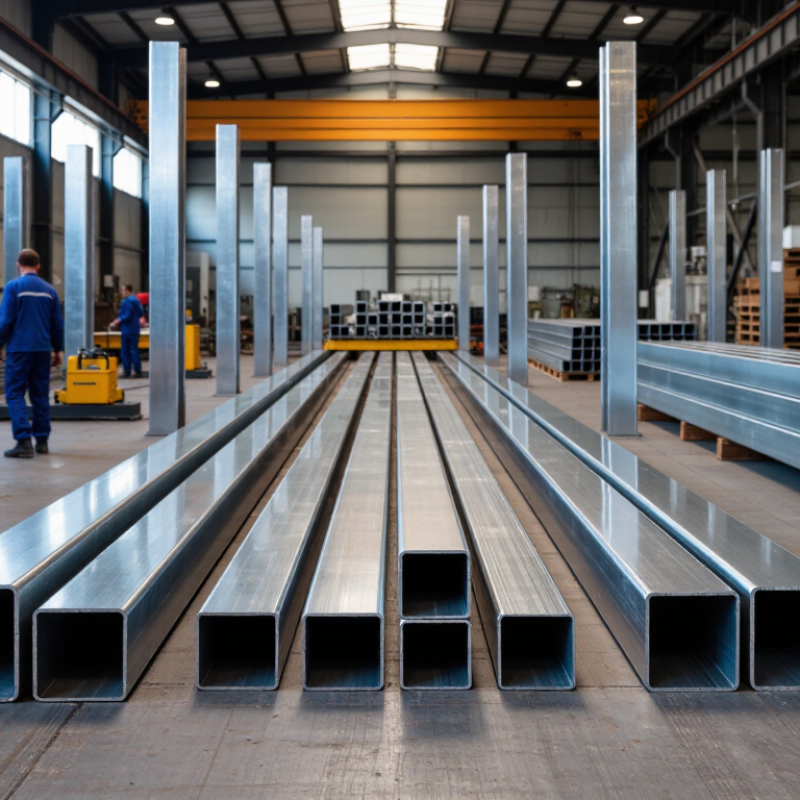
Square Tube Fundamentals: Hollow Sections and Efficient Load Paths
Square tube is a hollow structural section with four flat sides and a continuous internal void. Its geometry creates a direct, balanced path for axial loads, bending forces, and moderate torsion. The material works around the perimeter instead of filling the center, reducing weight without abandoning useful stiffness.
This efficiency matters in columns, roof frames, equipment supports, and modular structures. A square tube can align cleanly with floor grids and connect to plates using simple, repeatable details. Its closed shape also resists twisting better than many open sections. Small details matter. Wall thickness, corner radius, unsupported length, and steel grade affect buckling resistance. Engineers should check these values against the applicable design standard, not rely on appearance.
On site, I have seen square tubes perform well when cuts remain square and welds are properly sized. A 150-millimeter section may look substantial, yet thin walls can deform around a connection. That local weakness can interrupt the intended load path. Drainage and protective coatings also deserve attention, especially where moisture can enter through unsealed ends. Designers sometimes assume every force travels neatly through the tube. That assumption can fail. Connection eccentricity, fabrication tolerances, and temporary construction loads may shift stress into areas rarely shown in simple sketches. Careful inspection, clear drawings, and realistic load checks make the hollow section more dependable across different construction environments.
Global Steel Context: 1.89 Billion Tonnes Produced in 2023 (World Steel)
Why Choose Square Tube for Global Construction Projects?
Global steel production reached approximately 1.89 billion tonnes in 2023, according to World Steel Association’s World Steel in Figures 2024. This scale supports broad availability, but it also demands smarter material selection. Square tube uses steel efficiently around a hollow section. Its balanced geometry provides useful resistance in multiple directions. That matters for columns, frames, platforms, and modular structures exposed to changing loads. It also creates clean corners and repeatable connections. Fabricators often spend less time correcting irregular profiles.
Global projects face more than structural calculations. Transport space, local fabrication skills, coating systems, and inspection rules can change by region. Square tube is generally easy to stack and measure. Its flat faces simplify bolted plates, welding, and protective coating application. However, it is not automatically the best choice. A hollow section can trap moisture if detailing is poor. Wall thickness, corner radius, tolerances, and corrosion allowance need project-specific review. The International Energy Agency’s 2024 reports also highlight construction’s continuing pressure to reduce material and embodied emissions. Using less steel can help, but only when stability and durability remain adequate.
Tips: Check regional standards before ordering. Confirm mill certificates and traceability. Detail drainage and access holes carefully. Compare total installed cost, not only purchase price. A cheaper tube may create expensive site work. Review the design again. Small assumptions can become large global delays.
Sources: World Steel Association, World Steel in Figures 2024; International Energy Agency, Energy Technology Perspectives 2024.
Strength Benchmarks: ASTM A500 Grade B Requires 46 ksi Yield Strength
Square tube suits global construction because its four flat faces simplify connections, bracing, and architectural detailing. Yet appearance should not drive material selection. ASTM A500/A500M Grade B requires a minimum yield strength of 46 ksi and tensile strength of 58 ksi. These figures give engineers a clear baseline when reviewing structural drawings, mill certificates, and project substitutions.
Yield strength matters at the jobsite. A 46 ksi minimum means the tube can resist substantial stress before permanent deformation begins. In a frame, that margin supports predictable load paths around bolted plates, welded joints, and concentrated connection forces. The 2024 World Steel in Figures report recorded approximately 1.88 billion metric tons of crude steel production in 2023. Such scale reinforces why consistent specifications matter across international supply chains, where production quality can vary.
Still, strength alone is not enough. Wall thickness, corner radius, straightness, welding practice, and corrosion exposure can change real performance. A tube may meet the Grade B benchmark yet fail a poorly detailed connection. That is the uncomfortable part. Engineers should verify heat numbers, dimensions, test results, and coating requirements before installation. ASTM compliance is a starting point, not a complete design review. A square tube that looks robust can hide local buckling risks when slender walls carry compression. Careful inspection remains essential.
Design Compliance: EN 10219, Eurocode 3, and AISC HSS Standards
Square tube is widely selected for global construction because it combines efficient strength, clean geometry, and practical connections. Its equal sides simplify bracing layouts, façade frames, columns, and modular assemblies. Yet good geometry alone does not prove compliance.
Under EN 10219, cold-formed welded hollow sections require controlled dimensions, steel grades, tolerances, and production checks. Engineers then assess resistance and stability through Eurocode 3. Local buckling, compression, bending, and weld performance all matter.
A tube may appear robust but still need verification under combined loads. Small corner-radius differences can affect connection detailing.
Projects following AISC HSS standards require clear design values, wall-thickness considerations, and suitable connection methods. The engineer should confirm whether the section is manufactured and documented for the selected specification. Mill certificates, inspection records, and traceable dimensions support reliable approval. On site, measure actual wall thickness and check squareness before fabrication. Simple checks prevent expensive rework.
I have seen drawings pass review while connection forces remained poorly defined. That is a warning. Standards guide decisions, but they do not replace engineering judgment. A design may satisfy Eurocode 3 and still require adaptation for AISC practice, especially when terminology, resistance factors, and connection rules differ. Cross-border projects benefit from one coordinated compliance matrix, reviewed by qualified structural professionals.
Circular Construction: Steel Is 100% Recyclable (World Steel Association)
Why Choose Square Tube for Global Construction Projects?
Square tube supports circular construction because steel can return to production after a building’s service life. The World Steel Association reports that steel is 100% recyclable, without losing its essential properties. It also estimates that more than 680 million tonnes of steel are recycled globally each year. That recovery stream gives structural designers a practical material loop, not just a sustainability slogan.
On construction sites, square tubes offer predictable faces for bolted connections, brackets, and modular frames. Their hollow profile can reduce material use while maintaining useful strength-to-weight performance. When workers label the steel grade and separate it during demolition, recycling becomes easier. Clean sections stacked beside a cutting area are far more valuable than mixed scrap buried in debris.
Still, recyclability is not automatic. That matters. Coatings, concrete residue, and permanent composite joints can complicate recovery. The International Energy Agency identifies iron and steel production as responsible for about 7% of global energy-related carbon dioxide emissions. Designers should therefore specify durable sections, accessible connections, and realistic dismantling plans. A square tube is only circular when someone can remove, identify, and process it later. This is where project practice often falls short. More careful documentation could close that gap.
Why Choose Square Tube for Global Construction Projects? – Circular Construction: Steel Is 100% Recyclable
| Data Dimension | Square Steel Tube | Circular Steel Tube | Construction Relevance |
|---|---|---|---|
| Typical geometry used for comparison | 100 × 100 × 6 mm nominal section | 114.3 × 6 mm nominal section | Both examples use a 6 mm nominal wall thickness and are suitable for illustrating hollow-section behavior. |
| Calculated cross-sectional area | Approximately 2,256 mm² | Approximately 2,041 mm² | A larger cross-sectional area generally provides greater material availability for carrying axial force, subject to design checks. |
| Approximate mass per metre | Approximately 17.7 kg/m | Approximately 16.0 kg/m | Calculated using a nominal steel density of 7,850 kg/m³. Actual mass varies with tolerances and steel density. |
| Second moment of area about principal axes | Approximately 3.34 × 10⁶ mm⁴ about both principal axes | Approximately 3.00 × 10⁶ mm⁴ about any centroidal axis | Equal principal-axis properties make square tubes convenient where bending may occur in two perpendicular directions. |
| Section symmetry | Four-sided and symmetrical about two principal axes | Fully rotationally symmetrical | Square tubes simplify orientation, layout, and alignment; circular tubes provide uniform behavior regardless of rotational direction. |
| Connection and fabrication practicality | Flat faces support straightforward welding, bolting, cladding, and bracket attachment | Curved surfaces may require saddles, formed plates, or specialized connection details | Flat faces can reduce connection complexity in frames, modular structures, handrails, and architectural assemblies. |
| Space-efficient arrangement | Flat sides allow close placement and regular grid layouts | Gaps may occur between adjacent tubes unless special arrangements are used | Square sections can make efficient use of space in repetitive columns, frames, racks, and prefabricated modules. |
| Resistance to torsion | Closed hollow geometry provides good torsional efficiency compared with an open section of similar mass | Closed hollow geometry provides strong and uniform torsional behavior | Both profiles can be effective for bracing and members exposed to combined bending and torsion; final selection requires engineering verification. |
| Surface area for coating per metre | Approximately 0.376 m²/m for the outside perimeter of a 100 mm square | Approximately 0.359 m²/m for the outside circumference of a 114.3 mm diameter tube | Coating quantities depend on the complete exposed surface, coating system, preparation, and internal access. |
| Material recyclability | Steel is 100% recyclable and can be recycled repeatedly without losing its inherent properties. | Steel is 100% recyclable and can be recycled repeatedly without losing its inherent properties. | Steel components can support circular construction when they are designed for recovery, separation, reuse, and recycling at end of service life. |
| Potential design-for-disassembly benefit | Flat faces can facilitate bolted, accessible, and modular connections | Reusable connections are also possible but may require curved connection hardware | Mechanical connections, standardized lengths, and documented material grades can improve future reuse and recovery. |
| Global project suitability | Well suited to structural frames, columns, gates, modular buildings, façade supports, and equipment structures | Well suited to columns, trusses, handrails, curved structures, and applications requiring uniform resistance in all directions | Selection should consider local codes, available manufacturing capabilities, transport constraints, climate, fire requirements, and lifecycle objectives. |
